Animal Nutrition Strategy: From Feed to Farm | Camlin Fine Sciences
Animal nutrition is not limited to just formulation. The animals’ comfort, environment, digestion, and life stage all matter for improving productivity. Modern livestock production requires an integrated approach that encompasses feed, hygiene, biosecurity, and other factors to keep animals healthy and maximize farm productivity. In this article, we will closely discuss how feed solutions are not isolated but a key part of overall farm solutions.
What Is a Complete Animal Nutrition Strategy?
Feed solutions provide nutritional feed for animals based on their species, life stage, and needs. A complete animal nutrition strategy is a comprehensive, science-based plan that considers feed formulation, an animal’s nutrient requirements, the environment they live in, animal health, and production to ensure animals absorb nutrients efficiently, stay healthy, improve performance, and enhance overall farm productivity, while minimizing environmental impact.
Why Feed Quality Is the Starting Point
The quality of animal-derived food is closely linked to animal health and nutrition, both of which are influenced by feed quality. This makes feed quality an important starting point for farm health, productivity, and performance. Several factors can influence feed quality, and here are a few of them:
Raw materials: The quality and consistency of raw materials form the foundation of animal feed, influencing its nutritional value, safety, shelf life, and ultimately, animal performance. Poor-quality raw materials can lose nutritional value during processing and storage and may also be affected by oxidation, mold growth, or other forms of contamination. This can impact animal health, feed quality, and production costs.
Nutrient stability: Essential nutrients can become unstable during feed processing. Exposure to heat, moisture, oxygen, and other environmental conditions can break down the availability of certain vitamins and other nutrients, affecting the nutritional value of the final feed.
Oxidation: Exposure to oxygen can cause fats and other feed components to oxidize, resulting in a foul odor. It destroys fat-soluble vitamins and reduces the nutritional value of the feed, making it essential to use antioxidants and avoid exposing feed to oxygen during processing and storage.
Mold: Poor storage and excess moisture are the key causes of mold. When mold develops in feed or raw materials, it reduces the feed quality and nutritional value.
Mycotoxins: Mold can produce toxic substances, including mycotoxins, that develop in the presence of moisture and warmth, even if the mold is no longer visible. These substances reduce feed quality, suppress animals’ immune systems, reduce their food intake, and increase the risk of health issues.
Feed processing: Processes such as grinding, mixing, pelleting, and heat treatment directly influence nutrient availability and the physical quality of feed, making control essential, as excessive heat or insufficient processing can compromise nutrient quality and distribution.
Storage: Feed quality can continue to change after processing based on storage conditions. Exposure to moisture, oxygen, heat, and pests can cause nutrient degradation, oxidation, and mold growth.
The Role of Feed Solutions
Feed solutions help address specific risks posed by factors that affect feed quality and maintain its stability throughout production and storage. Every feed quality risk and intention requires different solutions. Here are a few key feed solutions:
Antioxidants
These solutions help slow oxidation in feed and protect components such as fats and oils from rancidity. They maintain nutrient quality and support feed stability during processing and storage.
Mold Inhibitors
These specialized chemical or biological compounds help prevent mold growth and disrupt fungal cellular processes when exposed to moisture. They strongly preserve feed nutrients throughout storage and transportation.
Toxin Binders
Like mold inhibitors, toxin binders are feed protectors that prevent mycotoxin contamination. They neutralize and prevent the absorption of harmful toxins present in feed ingredients.
Sanitizers
Feed contaminated with bacteria and microorganisms negatively impacts livestock health and productivity. Feed sanitizers provide antimicrobial protection and help protect animals from various pathogens that enter feed through ingredients, dust, the environment, and contaminated equipment.
Pellet Binders
These are functional feed additives added during pelleting to improve the physical integrity of feed. It helps strengthen the bonds between different feed particles, reducing breakage during cooling, transport, and handling while maintaining the feed’s nutritional value.
Other Nutritional Solutions
In addition to the above-mentioned feed solutions, you can also find energizers and other nutritional solutions that specifically support animal performance, gut health, digestion, and the ability to cope with stress, all of which can affect feed utilization.
Moving From Feed to Farm
Feed solutions deliver the best results when used as part of an integrated farm-management approach rather than in isolation. Good feed alone is not enough; animals must also be able to eat and drink freely, remain healthy, and cope with stress-inducing conditions to utilize the nutrients they consume and convert them efficiently into growth, milk, eggs, or meat.
Even a well-formulated ration can underperform if water is limited or contaminated, hygiene is poor, biosecurity is absent, housing is insufficient, or health management is weak. In such conditions, the potential of high-quality feed is lost to reduced intake, disease pressure, and environmental stress, leading to lower productivity and poorer returns on feed investment.
The Feed-to-Farm Framework
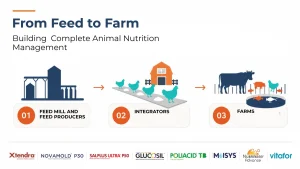
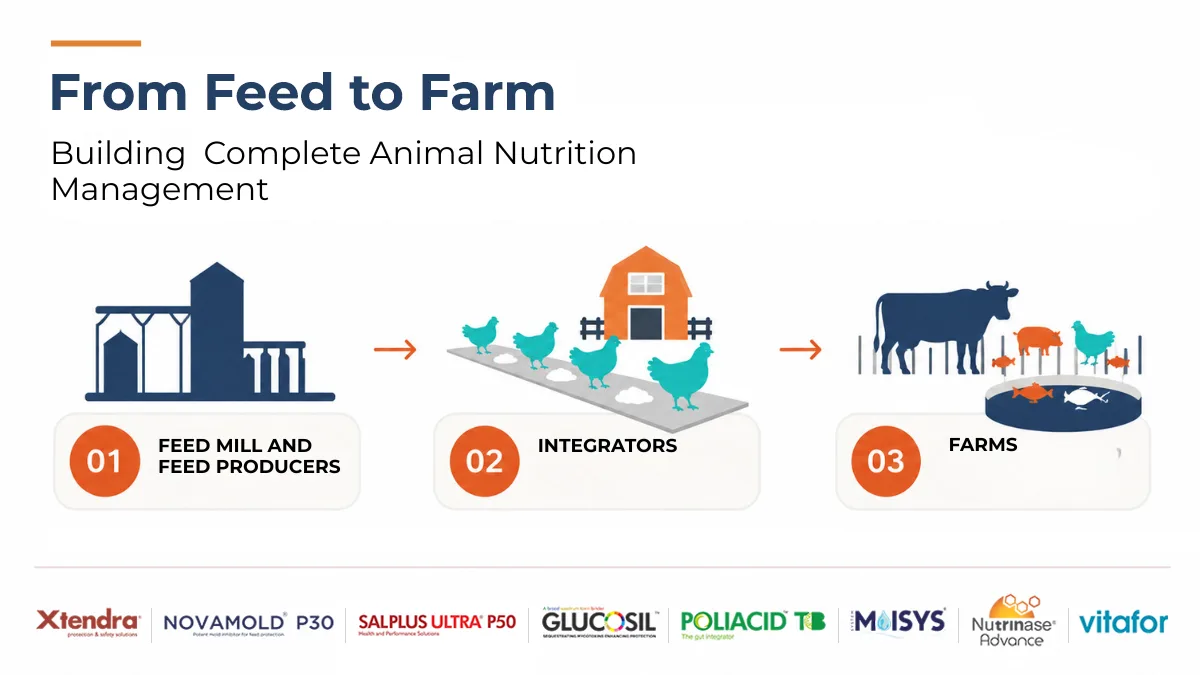
Feed solutions are the starting point and a key part of farm solutions. It’s a complete journey from raw materials to farm productivity. This entire journey can be viewed through a nine-step framework, in which every step is interconnected.
1. Raw Materials:
The quality, safety, and consistency of grains, oil seeds, by-products, and additives determine the supply of energy, protein, fiber, and micronutrients to livestock health and performance. Contaminants, high moisture, or poor storage at this stage can create risks later.
2. Feed Formulation:
Good formulation ensures nutrients are available in the right proportions for efficient use. Here’s where raw materials are strategically used to match energy, protein, amino acids, minerals, vitamins, and functional additives to the species, age, and production goal.
3. Feed Processing:
Proper processing of formulation reduces microbial load, improves pellet quality, and ensures each serving of feed delivers the intended nutrient profile to the livestock
4. Feed Protection:
Choosing the right feed protectors, like mold inhibitors, sanitizers, and toxin binders, helps to safeguard nutrients from chemical and biological damage like oxidation, mold growth, and more.
5. Feed Storage:
Proper moisture control, temperature management, pest control, and separation of raw materials and finished feed prevent quality loss, caking, mold development, and cross-contamination.
6. Animal Nutrition:
Correct ration distribution, feed frequency, access to clean and sufficient water, and comfort of livestock highly influence nutrition utilization and determine the productivity.
7. Farm Health & Hygiene:
Good hygiene ensures that nutrients are used for production rather than fighting infections. Biosecurity, cleaning and disinfection, litter and floor management, ventilation, and vaccination are important for keeping animals healthy and reducing stress.
8. Animal Performance:
This is where the combined effect of all previous steps becomes visible in day-to-day production data like feed intake, growth rate, milk yield, egg production, feed conversion ratio, fertility, and health status.
9. Farm Productivity:
Farm productivity is the result of a well-functioning feed-to-farm chain. Higher output per animal, better resource efficiency, lower mortality and treatment costs, and improved profitability and sustainability
Building a Strategy for Different Animal Production Systems
Farm solutions are not the same across all species. Each animal farm has its own challenges and risks. Hence, feed solutions should be tailored according to each species age, target issues, and production goals.
Poultry
Poultry farming exhibits rapid growth, high egg output, high metabolic rate, short production cycles, and high stocking densities, all of which require proper housing, precise feeding, clean water, effective ventilation, and reliable automation. They also require a strategic feed for different stages of birds.
While chicks require high-energy for immunity, adult birds need rich-protein feed for muscle growth and development. In poultry, small inefficiencies can multiply quickly over the short cycle, so feed-to-farm solutions need to prioritize quick response and consistent effort.
Dairy & Cattle
Dairy and cattle have long production cycles and a complex mix of different diets. This increases the risk of mold, mycotoxin contamination, and other issues. Hence, the feed-to-farm strategy for cattle needs to prioritize proper feed storage, litter and floor management, stable rations, and effective mycotoxin control.
Swine
Pigs are sensitive to infections and mycotoxins, which reduce feed intake and impair health. Besides, even the size of the feed and pellet quality determine pigs’ gut health, while a small size causes ulcers, and coarse feed reduces digestibility. The strategy for swine production should focus on mycotoxin control, clean water supply, biosecurity, and consistent feed quality.
Aquaculture
Aquafeeds are often high in protein and fat, with a high risk of lipid oxidation and mycotoxin contamination. Besides, poor-quality pellets also bring the risk of the feed breaking apart in water, causing nutrient loss and water pollution. Aquaculture’s feed-to-farm strategy should focus on oxidation control, strong water stability in pellets, high raw material quality, and mycotoxin control.
Measuring the Effectiveness of an Animal Nutrition Strategy
Once you have a nutrition strategy in place, it’s essential to monitor it regularly to assess its effectiveness and make changes as needed. In animal production, no single metric can determine the overall benefit of the strategy.
Feed quality, feed conversion, growth, health, morality, consistency, and economics should be evaluated together. However, each of these measures is influenced by many factors, including housing conditions, environmental stress, feed quality, genetics, and more. If feed efficiency, production, health, and farm economics improve after a change in nutrition, it’s a sign that the strategy is working. If there are mixed results, factors such as disease, environment, or farm management may need adjustments.
Why an Integrated Approach Matters
Maximum productivity and profitability in animal production do not come from isolated good feed. Instead, it requires an integrated approach that combines feed solutions, farm solutions, management practices, and consistent monitoring.
Livestock grow, produce, and stay healthy in a safe, comfortable environment with good hygiene, clean water, good feed, reduced stress, and regular vaccination. Weaknesses in any aspect of farm management can affect nutrient utilization and overall productivity.
Camlin Fine Sciences: Building a Feed-to-Farm Strategy
At Camlin Fine Sciences, our portfolio and technical support team help farms build a feed-to-farm strategy aligned with their livestock species, age, size, and target concerns. From protecting feed quality with additives to supporting on-farm performance and profitability.
Camlin Fine Sciences brings formulation expertise, application testing, and technical services to help customers select the right antioxidant, mold inhibitor, or toxin binder for their specific raw material profiles, species, and climatic conditions. We also help them optimize feed processing and storage practices to maintain feed quality and physical integrity, while integrating the feed solution with on-farm monitoring of growth, health, and economic indicators to track the return on investment.
Conclusion
Modern animal nutrition requires a complete value chain approach, as every step connects with the others and ultimately determines overall livestock performance and productivity. Feed quality is the starting and most critical part of this system.
But it brings results only if it uses the right approach, with high-quality raw materials, proper feed formulation, controlled processing, a protection strategy, and well-managed storage, along with on-farm health, hygiene, environmental, and floor management. With this integrated approach, animals stay healthy enough to convert nutrients efficiently into growth, milk, eggs, or meat.
FAQs
What is an animal nutrition strategy?
Animal nutrition strategy is a systematic approach to animal feeding designed to improve health, growth, and productivity while managing feed costs and environmental impact.
Why is feed quality important for livestock?
Feed quality is the starting point for effective farm management. Good-quality feed provides the nutrients animals need for growth, health, reproduction, and production. Feed quality also supports better feed utilization, animal performance, and overall farm efficiency.
What is the difference between feed solutions and farm solutions?
Feed solutions are part of farm solutions, which focus on feed quality, raw materials, ingredients, additives, and feeding practices tailored to animals’ needs. Farm solutions covering water quality, animal health, hygiene, housing, biosecurity, and overall farm management, along with feed.
How can feed and farm management work together?
Good-quality feed provides the nutrients animals need, while proper water management, hygiene, housing, biosecurity, and health practices help them use those nutrients effectively.
What factors influence livestock productivity?
Factors such as feed and nutrition, water quality, animal health, hygiene, housing, environment, genetics, and farm management influence livestock productivity.