Why Antioxidants Are Essential for Shelf-Life Extension in Animal Feed
Across the global animal nutrition industry, manufacturers face a persistent and underestimated challenge: keeping feed ingredients and finished products stable from production through to final consumption. Antioxidants are a critical line of defense in this effort. From poultry meal to rendered fats and pet food formulations, antioxidants play a foundational role in feed protection and shelf life for food-grade raw materials used in animal nutrition. As feed producers seek reliable ways to maintain ingredient integrity and product performance across extended supply chains, the importance of purpose-built antioxidant solutions continues to grow.
What Are Antioxidants, and Why Are They Used in Animal Feed?
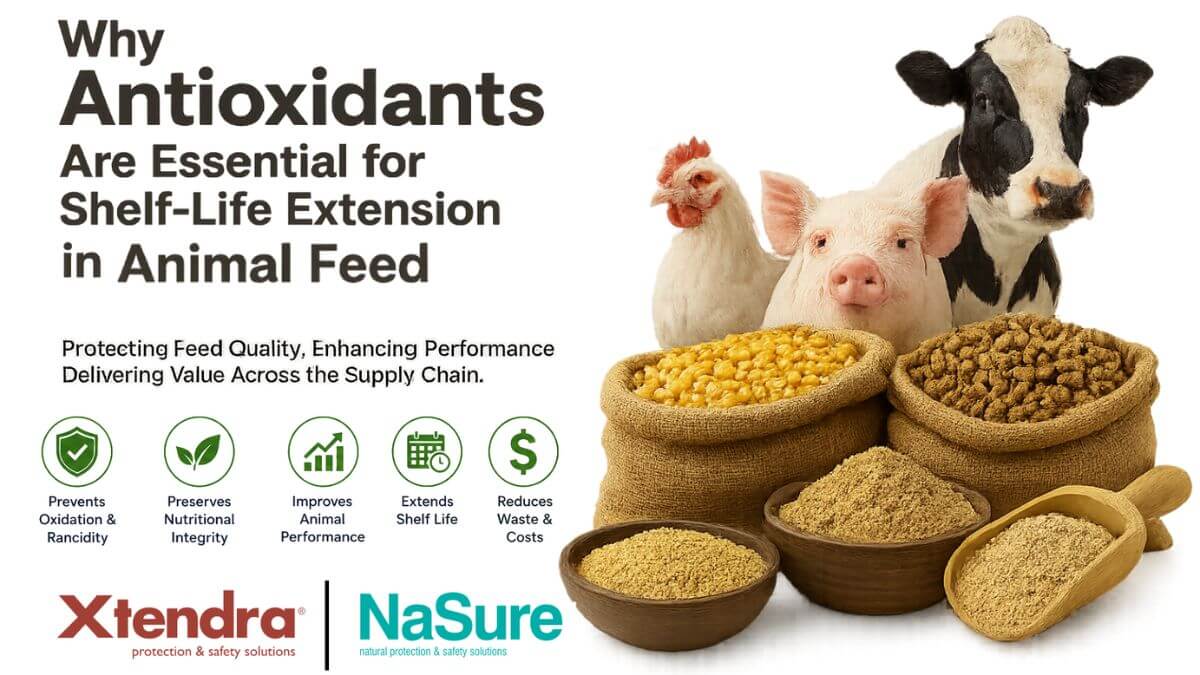
Antioxidants are an integral part of food protection that are widely used in feed protection to prevent rancidity, maintain nutritional integrity, protect palatability, and extend shelf life for food-grade and feed-grade ingredients throughout the supply chain. Antioxidants inhibit or slow the oxidation of fats, oils, and other lipid-containing materials in feed products. Without effective antioxidant protection, lipid-rich feed materials degrade much faster, resulting in nutritional degradation, reduced palatability, and significant waste.
Antioxidants are used across a wide range of feed industry applications: rendered fats, poultry meal, compound feed, premixes, and pet food. In each of these categories, oxidation directly affects ingredient quality, animal performance, and the overall economics of production. Feed manufacturers also increasingly explore natural antioxidant systems that can offer effective protection while meeting evolving regulatory and formulation requirements.
What Is Oxidation — and Why Is It a Particular Challenge in Feed Protection?
Oxidation is a chemical process that occurs when fats, oils, and lipids come into contact with oxygen. In feed systems, it is one of the leading causes of quality deterioration — and unlike in many food products, feed ingredients often undergo extended storage and complex multi-stage logistics before reaching end use. Lipid oxidation in feed contexts is not merely a sensory concern; it is a nutritional and performance issue.
Oxidized fats in animal feed reduce the bioavailability of fat-soluble vitamins such as A, D, E, and K. They generate toxic aldehydes and secondary oxidation products that can impair animal health and growth performance. They reduce palatability, causing reduced feed intake — which directly affects feed conversion ratios and productivity. This is why antioxidants in feed systems are considered operationally essential, not merely a precautionary measure.
Feed ingredients such as rendered poultry fat, and vegetable oils are particularly vulnerable because of their high polyunsaturated fatty acid (PUFA) content. The role of antioxidants in protecting these materials is especially important in animal nutrition applications where ingredient quality directly determines end-product performance.
How Do Antioxidants Actually Extend Shelf Life in Feed Products?
Antioxidants extend the shelf life of feed ingredients and finished products by interrupting the chain reaction of lipid oxidation at the molecular level. Fats oxidize through three stages — initiation, propagation, and termination. Left unchecked, oxidation compounds rapidly, and what begins as invisible degradation can quickly render feed materials nutritionally compromised.
Antioxidants work by donating hydrogen atoms to unstable free radicals, effectively neutralizing them before they trigger further damage. This mechanism explains how antioxidants protect feed quality and why they are deployed at multiple points across the production and storage chain. Depending on the antioxidant system selected, protection can extend the effective shelf life for food-grade and feed-grade materials by weeks or even months — a critical factor in industries with complex international supply chains.
The protective role of antioxidants is especially important in feed products exposed to heat during processing (pelleting, extrusion), high ambient temperatures during transport, and extended storage in warm or humid environments — all conditions commonly encountered in feed supply chains across tropical and sub-tropical markets.
What Is the Difference Between Synthetic and Natural Antioxidants in Feed Applications?
The choice between synthetic and natural antioxidants in feed formulation depends on several factors, including regulatory requirements in the target market, the specific feed matrix being protected, cost considerations, and whether the end product carries any claims related to natural or additive-minimal formulations.
Synthetic antioxidants — including ethoxyquin, BHA (butylated hydroxyanisole), BHT (butylated hydroxytoluene), and Propyl Gallate — have a well-established history in the feed industry. They are effective at low concentrations, thermally stable, and widely registered across major regulatory jurisdictions
Natural antioxidants — derived from rosemary, green tea, mixed tocopherols, and other plant sources — are increasingly being adopted in feed formulations where synthetic alternatives face regulatory scrutiny or where formulators seek plant-derived protection systems. Their effectiveness in high-fat feed matrices continues to improve through advanced extraction and blending technologies.
Are Natural Antioxidants as Effective as Synthetic Ones for Feed Protection?
When properly formulated and applied at the correct inclusion level and processing stage, natural antioxidants can deliver performance comparable to synthetic alternatives. The feed industry has seen a meaningful shift towards natural protection systems in certain segments — particularly in animal feed, premium pet food, and organic or additive-minimized compound feed — driven by both regulatory developments and market positioning requirements.
Effectiveness, however, is never one-size-fits-all. The fat type, moisture content, processing temperature, and storage conditions of each feed product determine which antioxidant system will deliver the required protection. This is why application-specific formulation expertise is essential — and why partnering with experienced manufacturers is consistently more reliable than selecting off-the-shelf products.
Which Feed Products and Ingredients Commonly Require Antioxidant Protection?
- Rendered poultry and animal fats — critical to protect during both production and storage
- Compound feed for poultry, swine, and ruminants — fat inclusion levels make antioxidant protection standard practice
- Premixes and vitamin-mineral blends — where oxidation can compromise the stability of fat-soluble vitamins
- Pet food formulations — where palatability and nutritional integrity are primary quality parameters
- Extruded and pelleted feed — processing heat accelerates oxidation risk at the point of production
- Feed ingredients in storage and transit — especially in warm and humid climates where ambient oxidation rates are higher
For each of these categories, antioxidants are not a discretionary addition — they are a fundamental requirement of responsible feed formulation and manufacturing.
When Should Antioxidants Be Added During Feed Manufacturing?
Antioxidants are most effective when added before oxidation begins. In feed manufacturing, this means incorporating them at the ingredient level — during fat and oil processing, at the point of rendering — rather than waiting until the final feed blend stage.
What Are the Operational and Commercial Risks of Not Using Antioxidants in Feed?
The key risks include:
- Reduced animal performance — oxidized fats impair energy utilization and reduce feed conversion efficiency
- Nutritional degradation — fat-soluble vitamin destruction compromises the nutritional profile of the finished feed
- Palatability concerns — animals consistently show reduced intake when feed contains oxidized fats, directly affecting growth rates
- Raw material waste and supply chain costs — compromised ingredients that cannot be used represent direct financial impact
- Regulatory and quality system non-conformances — particularly in export markets where ingredient quality specifications are stringently enforced
The commercial argument is straightforward: the cost of incorporating antioxidants into feed production is consistently lower than the cumulative cost of these downstream issues. For export-oriented feed manufacturers, supplying demanding international markets, effective antioxidant protection is an operational requirement.
How Do You Choose the Right Antioxidant for Your Feed Product?
This is where formulation science meets commercial strategy — and where the choice of supply partner becomes genuinely important.
The right antioxidant system for a feed application depends on a carefully assessed combination of variables: the type and PUFA content of the fat or oil in the formulation, the processing temperatures and conditions, the target shelf life and storage environment, the regulatory requirements of the destination market, and whether the formulation has any natural or clean-label positioning requirements.
This is precisely why companies like Camlin Fine Sciences build their feed antioxidant offering around customized, application-specific formulations. Whether the requirement is a proven synthetic blend from the Xtendra® range or a natural plant-derived solution from the NaSure™ portfolio, the right answer is always the one matched to the specific product, process, and market — not simply the easiest option to source.
Antioxidants are foundational to modern feed manufacturing. They protect the integrity of raw materials, maintain the nutritional quality of finished feed, support animal performance, and enable manufacturers to deliver consistent products across complex global supply chains.
As the feed industry evolves — with increasing regulatory scrutiny of certain synthetic additives, growing interest in natural protection systems, and rising expectations around product quality and traceability — the antioxidant category continues to develop in response. From established synthetic solutions with proven efficacy to sophisticated plant-based alternatives, both the science and the commercial offering are advancing.
For feed manufacturers, pet food formulators, and procurement teams across the animal nutrition industry, the question was never really whether to use antioxidants. It has always been about which ones to use — and when.